How NMC Health's Emergency Department Expansion Transformed Staff Culture and Collaboration
 (Dec. 12, 2025) – The Kansas Hospital Association appreciates the opportunity to highlight workforce strategies that honor employees, providers or volunteers who make significant contributions to the well-being, retention or recruitment of health care workers at their facility. Thank you to NMC Health for sharing their strategies.
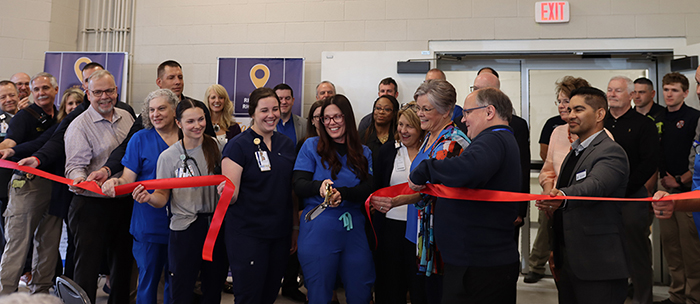
When NMC Health identified a rare ARPA-funded opportunity through the Kansas Department of Health and Environment's Rural Health Innovations Grant, the project quickly evolved from just a construction effort to a workforce strategy. With only 14 months to design, fund and complete a major emergency department expansion, NMC Health used this moment to engage its staff, strengthen cross-departmental relationships and cultivate a more agile, collaborative workforce culture.
"This project was absolutely a workforce goal, " said Val Gleason, president and CEO of NMC Health. "We had to put the pedal to the metal and move as one big unit. That's what made it successful."
To meet the tight timeline, NMC Health established a multidisciplinary steering group that functioned like an incident command center—a model the staff was already familiar with from emergency preparedness training. This structure became the foundation of the project's workforce strategy.
"We appointed a core team to steer the project, " Gleason said. "Directors from nursing, registration, environmental services, infection control, hospital executives and our grant manager were all at the table. Then we brought in subject-matter experts as needed. People moved in and out seamlessly."
That fluidity strengthened organizational trust and highlighted staff capability. As Gleason noted, "It worked really well. It let people see each other's strengths across departments."
Years of internal emphasis on project-management skills paid off when staff suddenly had to apply them on a massive scale.
"One of the most helpful things was that we had already taught project management as part of our leadership curriculum, " Gleason said. "The architects didn't have to coach us. We could speak a common language."
Staff who previously managed smaller projects now participated in a systemwide effort—expanding the psychiatric care area, adding a fast-track zone and doubling chemical decontamination capacity while keeping the emergency department fully operational. The experience enhanced confidence, accountability and interdisciplinary problem-solving.
The project also fostered a new sense of employee ownership. Since two-thirds of the funding had to come from local sources, staff participation in the employee giving campaign became a significant workforce achievement.
Gleason shared a memorable moment: a staff nurse who had previously worked in another profession was meeting with the development director about her financial gift for the project. She said, "I'm happy to give." She paused a moment and then said, "I just realized I'm a philanthropist! I've always dreamed of being a philanthropist! " Moments like that showed how deeply the workforce believed in this project.
Every member of the administration and the board participated, along with a large number of staff, physicians and community supporters.
The resulting space not only enhances patient flow but also improves the work environment. Staff benefit from quieter zones, clearer workflows, safer registration areas, and more efficient throughput.
"Our efficiency is up, our left-without-being-seen rate is down and the whole hospital feels calmer and more coordinated," Gleason said. "This project strengthened our workforce. We see what we're capable of – together."
What started as a tight deadline became a defining workforce achievement, demonstrating that when NMC Health's employees rally around a shared mission, they can create far more than just a new ED—they can foster a stronger culture.
--Shelby Stacy